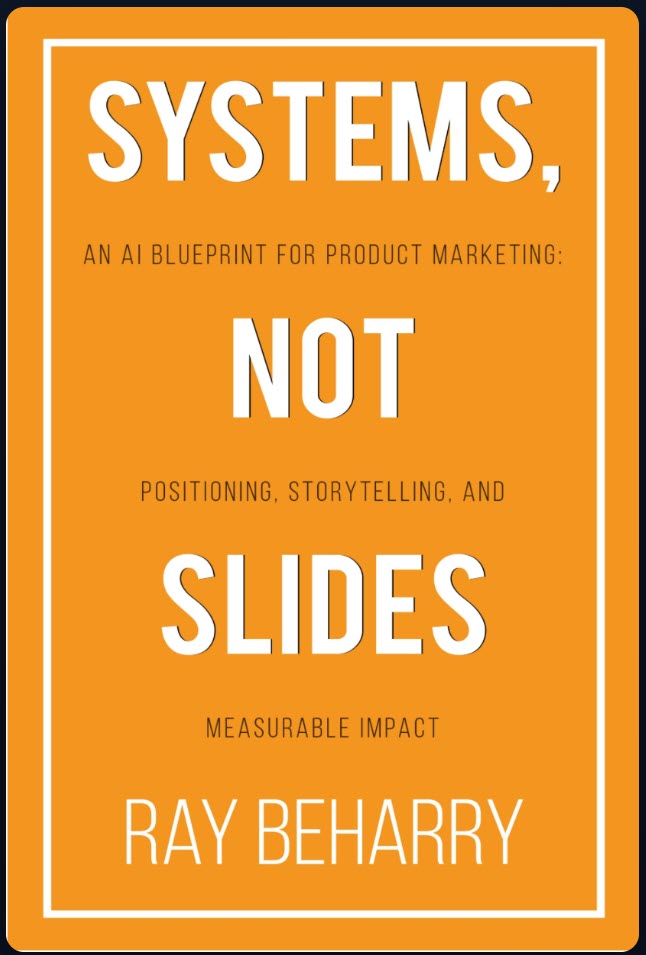
A book by Ray Beharry. Review by Gary Dietz.
Review by Gary Dietz 22 Feb 2026
From the title to the first chapter, I thought that this short volume made a number of broad claims, that, frankly I’ve heard before:
- It’s a new era in product marketing!
- We used to translate and tell stories, and now we do much more. Or at least we have to in order to thrive.
- PMM’s new role is even more strategic and we need to adapt and grow to meet the challenge.
Yadda yadda yadda… Uh-oh, what am I in for? Another “Captain Obvious” business book? Turns out, captain obvious wasn’t in the room. It was really a good read, with caveats.
I briefly saw a reference to this book on a blog Mr. Beharry published on the Product Marketing Alliance AI Slack channel, and saw Mr. Beharry’s LinkedIn profile, so I decided to give the book a chance based on this street cred. The book engendered five questions in my mind:
- Is this book a sales enablement framework? A framework? (I have so many feelings about that word!)
- Is this book a way to apply current (and possibly future) AI automations against that Framework?
- Is this book a “freeze frame in time” of a summary of a tools stack that can be applied, today, to execute?
- Does this book have a few odd parenthetical comments that look like prompts to an AI that were not cleaned up before publication?
- Did I love this book?
Yes, Yes, Yes, I think so, and Yes.
I really liked what he is doing with this volume. To me, it really seems to be two very important books in one, covering two very important things — things I assume (and hope!) he teaches in detail at Rutgers and that he executes at his position at IBM (per LinkedIn).
The first is a series of key things that not all marketing leaders, general business press, and workplace pundits have yet to fully synthesize and add to their teams’ strategic arsenal. Things that Mr. Beharry succinctly summarizes will resonate differently with different people across different roles and points in their careers.
For me, the strategic heart of this volume is when Mr. Beharry says, “AI will do more work. You will do more meaning.” My opinion is that Mr. Beharry should have emphasized this directly at the start of the book as its deepest thesis. It sort of did, but for me it didn’t hit hard until the last chapter when it was said explicitly. One more pass of edits to move that statement and some more supports to it at the beginning of the book could have helped me a lot. It’s so very essential.
This volume also illustrates and explains how AI deeply impacts a few PMM tactics by articulating what is enhanced by AI and what is still human. For example in reporting and metrics, Mr. Beharry says, “AI can tell you what moved. Only you can decide why — and what to do next. Your value isn’t prettier dashboards; it’s clear calls with the courage to cut beloved but ineffective work, double-down on what pays, and ask for resources where the system proves leverage. That’s executive trust.”
He provides similar structural “executive trust” insights into AI-powered PMM activities (did I use the term “AI-powered?”) such as Research and Marketing Intelligence, Message Resonance, Launches, Dynamic, real-time sales enablement, and more.
The second book that this work seems to encompass is a framework, almost a workbook, of step-by-step approaches to the discrete elements product marketing managers do. These are useful, and seem divided into two kinds of lists. (1) Frameworks and applied examples which are (2) Broken into things to do and (today’s) recommended tool stacks to do them.
There is a lot to dig into in this book, and I can see it being really useful to both “generalist” PMMs and PMMs who specialize in only subsets of the author’s coverage. In Q1 2026, the specific tools in these passages are undoubtedly key to explore. I assume that this will continue to change rapidly. (A project I did with Claude in Fall 2025 was totally changed in approach by February 2026 because of AI tech change!)
Why did I love this book?
This book confirmed that the positive ideas, approaches, and impacts I have been teaching myself and noticing unfold across our industry are real. And that many folks are misunderstanding what the real opportunities and threats are to the future of the PMM industry, marketing, business, and employment as a whole.
The excellent advice in this book is slowed down by a visual mind like mine because of two things I wish Mr. Beharry would have done:
(1) Add more conceptual and workflow illustrations.
(2) Break out and expand the opinions and research to support the strategic suppositions into longer sections, broken up by said illustrations and figures that would help me better contextualize and understand these strategic points.
I can only assume that Mr. Beharry is already and will present this information in other formats and channels over time such as live presentations, workshops, or slide decks.
I’m looking forward to digging deeper into his work.
Leave a Reply